

CVPR 2026: The Universal Normal Embedding

C. Tasker, R. Betser, E. Gofer, M-Y Levi, G. Gilboa, CVPR 2026.

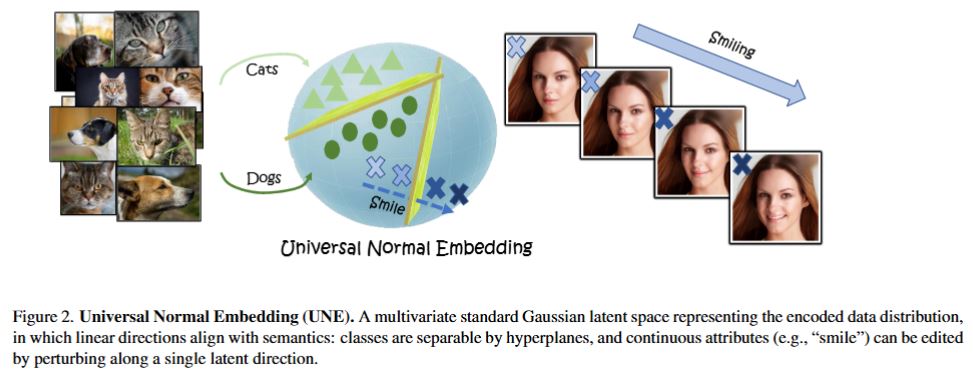
Generative models and vision encoders have largely advanced on separate tracks, optimized for different goals and grounded in different mathematical principles. Yet, they share a fundamental property: latent space Gaussianity. Generative models map Gaussian noise to images, while encoders map images to semantic embeddings whose coordinates empirically behave as Gaussian. We hypothesize that both are views of a shared latent source, the \emph{Universal Normal Embedding (UNE)}: an approximately Gaussian latent space from which encoder embeddings and DDIM-inverted noise arise as noisy linear projections. To test our hypothesis, we introduce \emph{NoiseZoo}, a dataset of per-image latents comprising DDIM-inverted diffusion noise and matching encoder representations (CLIP, DINO). On CelebA, linear probes in both spaces yield strong, aligned attribute predictions, indicating that generative noise encodes meaningful semantics along linear directions. These directions further enable faithful, controllable edits (e.g., smile, gender, age) without architectural changes, where simple orthogonalization mitigates spurious entanglements. Taken together, our results provide empirical support for the UNE hypothesis and reveal a shared Gaussian-like latent geometry that concretely links encoding and generation.
Paper

Project page

Medium post


NeuReps 2025 (NeurIPS workshop): Tracking Memorization Geometry throughout the Diffusion Model Generative Process

Jonathan Brokman, Itay Gershon, Omer Hofman, Guy Gilboa, Roman Vainshtein

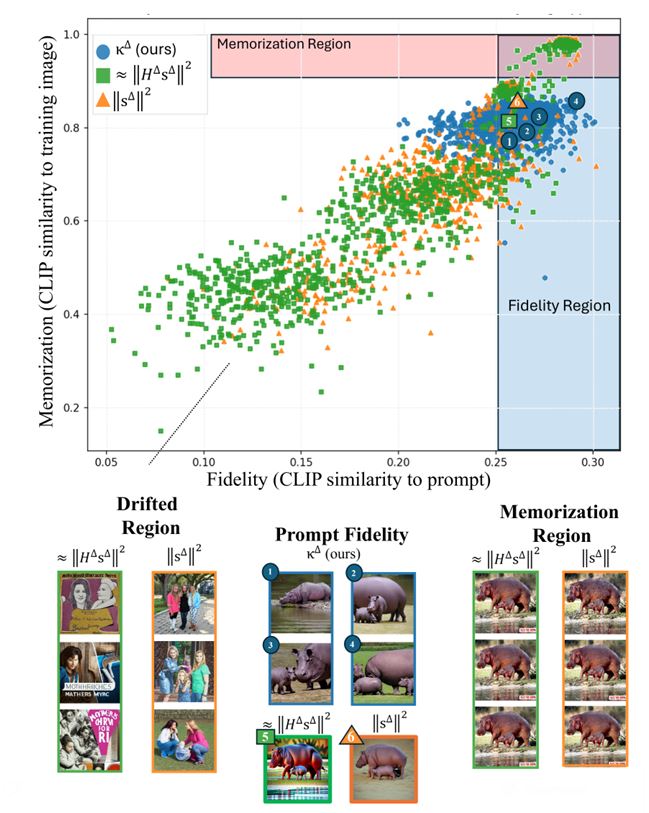
Memorization in generative text-to-image diffusion models is a phenomenon where instead of valid image generations, the model outputs near-verbatim reproductions of training images. This poses privacy and copyright risks, and remains difficult to prevent without harming prompt fidelity. We present a mid-generation, geometry-informed criterion that detects, and then helps avoid (mitigate), memorized outputs. Our method analyzes the natural image distribution manifold as learnt by the diffusion model. We analyze a memorization criterion that has a local curvature interpretation. Thus we can track the generative process, and our criterion’s trajectory throughout it, to understand typical geometrical structures traversed throughout this process. This is harnessed as a geometry-aware indicator that distinguishes memorized from valid generations. Notably, our criterion uses only the direction of the normalized score field, unlike prior magnitude-based methods; combining direction and magnitude we improve mid-generation detection SOTA by %. Beyond detecting memorization, we use this indicator as a plug-in to a mitigation policy to steer trajectories away from memorized basins while preserving alignment to the text. Empirically, this demonstrates improved fidelity–memorization trade-off over the competitors. By linking memorization to magnitude-invariant geometric signatures of the generative process, our work opens a new direction for understanding—and systematically mitigating—failure modes in diffusion models. Official code: https://bit.ly/4ndeISd

PDF