
WACV 2026: General and Domain-Specific Zero-shot Detection of Generated Images via Conditional Likelihood

Roy Betser, Omer Hofman, Roman Vainshtein, Guy Gilboa, “General and Domain-Specific Zero-shot Detection of Generated Images via Conditional Likelihood”, accepted to Winter Conference on Applications of Computer Vision (WACV) 2026.

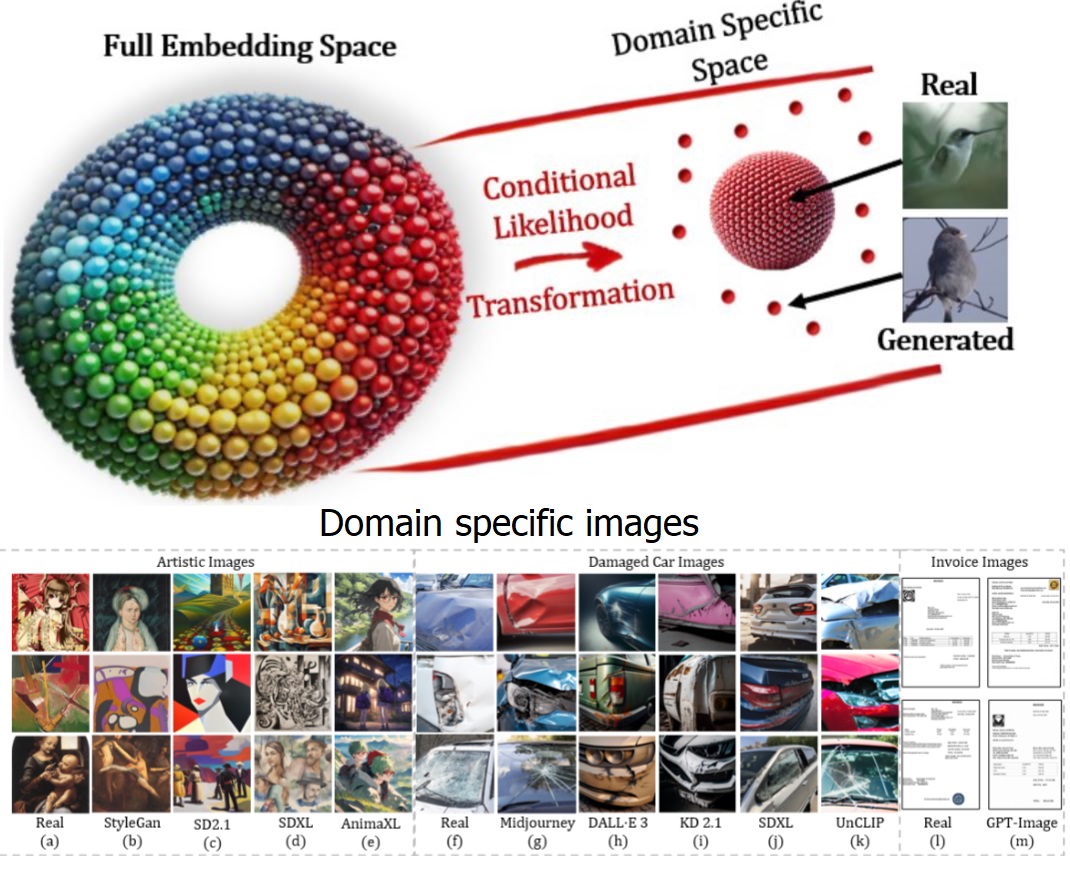
The rapid advancement of generative models, particularly diffusion-based methods, has significantly improved the realism of synthetic images. As new generative models continuously emerge, detecting generated images remains a critical challenge. While fully supervised, and few-shot methods have been proposed, maintaining an updated dataset is time-consuming and challenging. Consequently, zero-shot methods have gained increasing attention in recent years. We find that existing zero-shot methods often struggle to adapt to specific image domains, such as artistic images, limiting their real-world applicability. In this work, we introduce CLIDE, a novel zero-shot detection method based on conditional likelihood approximation. Our approach computes likelihoods conditioned on real images, enabling adaptation across diverse image domains. We extensively evaluate CLIDE, demonstrating state-of-the-art performance on a large-scale general dataset and significantly outperform existing methods in domain-specific cases. These results demonstrate the robustness of our method and underscore the need of broad, domain-aware generalization for the AI-generated image detection task.

Project page

Medium post

Data

Arxiv paper

Code


ICLR 2025: Manifold Induced Biases for Zero-shot and Few-shot Detection of Generated Images

Jonathan Brokman · Amit Giloni · Omer Hofman · Roman Vainshtein · Hisashi Kojima · Guy Gilboa, ICLR 2025

Abatract:

Distinguishing between real and AI-generated images, commonly referred to as ‘image detection’, presents a timely and significant challenge. Despite extensive research in the (semi-)supervised regime, zero-shot and few-shot solutions have only recently emerged as promising alternatives. Their main advantage is in alleviating the ongoing data maintenance, which quickly becomes outdated due to advances in generative technologies. We identify two main gaps: (1) a lack of theoretical grounding for the methods, and (2) significant room for performance improvements in zero-shot and few-shot regimes. Our approach is founded on understanding and quantifying the biases inherent in generated content, where we use these quantities as criteria for characterizing generated images. Specifically, we explore the biases of the implicit probability manifold, captured by a pre-trained diffusion model. Through score-function analysis, we approximate the curvature, gradient, and bias towards points on the probability manifold, establishing criteria for detection in the zero-shot regime. We further extend our contribution to the few-shot setting by employing a mixture-of-experts methodology. Empirical results across 20 generative models demonstrate that our method outperforms current approaches in both zero-shot and few-shot settings. This work advances the theoretical understanding and practical usage of generated content biases through the lens of manifold analysis.

camera ready version


Code