
CVPR 2026: Training-free detection of generated videos via spatial-temporal likelihoods

O. Ben Hayun, R. Betser, M-Y Levi, L. Kassel, G. Gilboa, CVPR 2026.

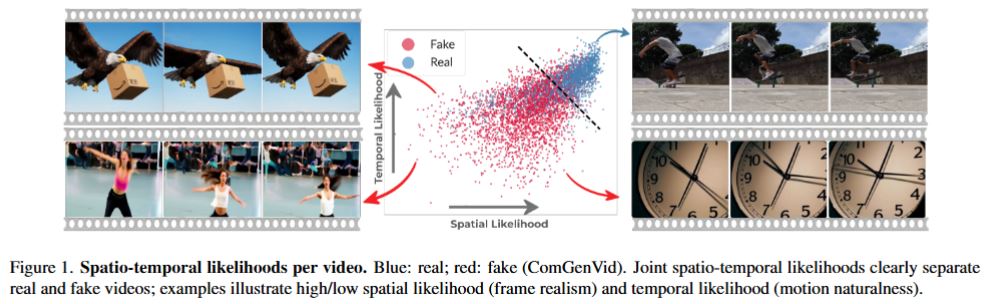
Following major advances in text and image generation, the video domain has surged, producing highly realistic and controllable sequences that transform creative workflows. Along with this progress, these models also raise serious concerns about misinformation, making reliable detection of synthetic videos increasingly crucial. Image-based detectors are fundamentally limited because they operate per frame and ignore temporal dynamics, while supervised video detectors generalize poorly to unseen generators, a critical drawback given the rapid emergence of new models.These challenges motivate zero-shot approaches, which avoid synthetic data and instead score content against real-data statistics, enabling training-free, model-agnostic detection.
We introduce STALL, a simple, training-free, theoretically justified detector that provides likelihood-based scoring for videos, jointly modeling spatial and temporal evidence within a probabilistic framework. Across two public benchmarks including 20 generative models, STALL consistently outperforms prior image- and video-based baselines. To further test generalization, we curate ComGenVid, a new benchmark featuring state-of-the-art models (Sora and Veo-3), on which STALL demonstrates consistent and robust results.

Paper

Project page

Medium post


WACV 2026: General and Domain-Specific Zero-shot Detection of Generated Images via Conditional Likelihood

Roy Betser, Omer Hofman, Roman Vainshtein, Guy Gilboa, “General and Domain-Specific Zero-shot Detection of Generated Images via Conditional Likelihood”, accepted to Winter Conference on Applications of Computer Vision (WACV) 2026.

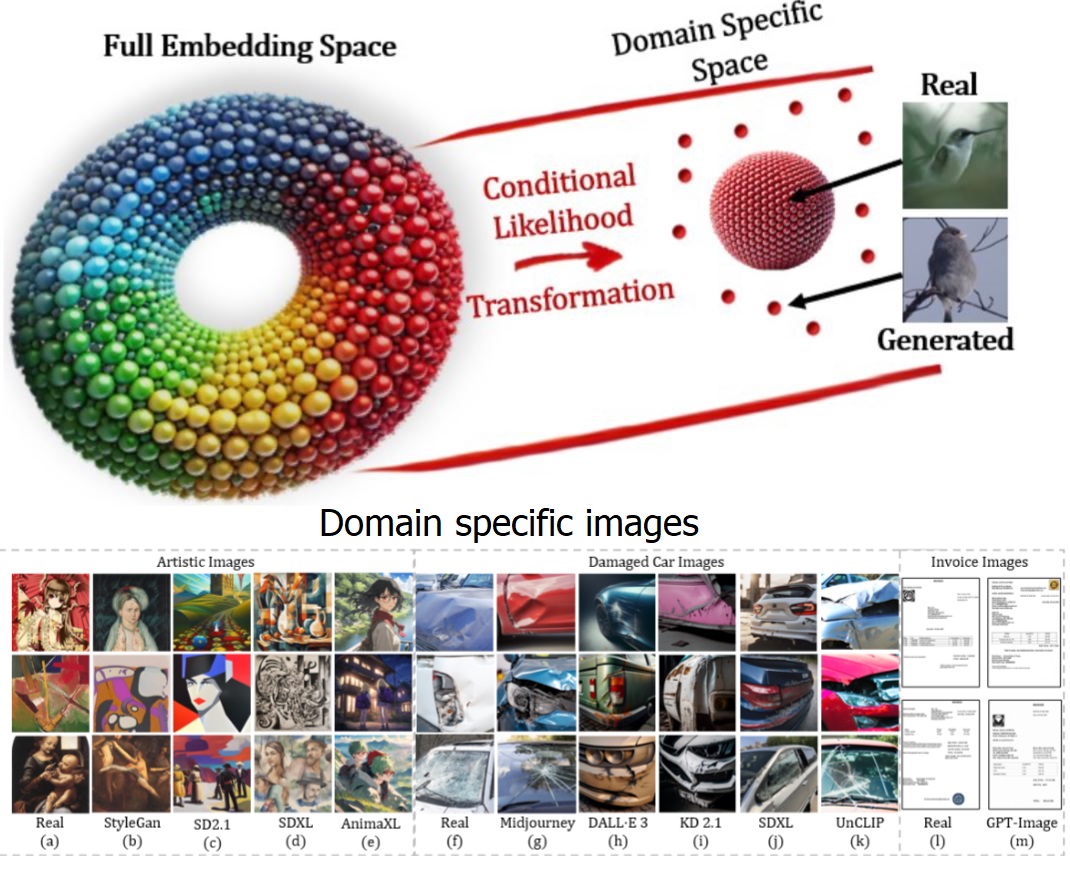
The rapid advancement of generative models, particularly diffusion-based methods, has significantly improved the realism of synthetic images. As new generative models continuously emerge, detecting generated images remains a critical challenge. While fully supervised, and few-shot methods have been proposed, maintaining an updated dataset is time-consuming and challenging. Consequently, zero-shot methods have gained increasing attention in recent years. We find that existing zero-shot methods often struggle to adapt to specific image domains, such as artistic images, limiting their real-world applicability. In this work, we introduce CLIDE, a novel zero-shot detection method based on conditional likelihood approximation. Our approach computes likelihoods conditioned on real images, enabling adaptation across diverse image domains. We extensively evaluate CLIDE, demonstrating state-of-the-art performance on a large-scale general dataset and significantly outperform existing methods in domain-specific cases. These results demonstrate the robustness of our method and underscore the need of broad, domain-aware generalization for the AI-generated image detection task.

Project page

Medium post

Data

Arxiv paper

Code


ICML 2025: Whitened CLIP as a Likelihood Surrogate of Images and Captions

Roy Betser, Meir-Yossef Levi, Guy Gilboa

Proceedings of the 42nd International Conference on Machine Learning (ICML), 2025

Likelihood approximations for images are not trivial to compute and can be useful in many applications. We examine the use of Contrastive Language-Image Pre-training (CLIP) to assess the likelihood of images and captions. We introduce \textit{Whitened CLIP}, a novel transformation of the CLIP latent space via an invertible linear operation. This transformation ensures that each feature in the embedding space has zero mean, unit standard deviation, and no correlation with all other features, resulting in an identity covariance matrix. We show that the whitened embeddings statistics can be well approximated as a standard normal distribution, thus, the log-likelihood is estimated simply by the square Euclidean norm in the whitened embedding space. The whitening procedure is completely training-free and performed using a pre-computed whitening matrix, hence, is very fast. We present several preliminary experiments demonstrating the properties and applicability of these likelihood scores to images and captions.

Camera ready version.


Code