imeg

Nonlinear Scale Space with Spatially Varying Stopping Time

G. Gilboa, “Nonlinear Scale Space with Spatially Varying Stopping Time”, PAMI, Vol. 30, No. 12, pp. 2175-2187, 2008.

Abstract:

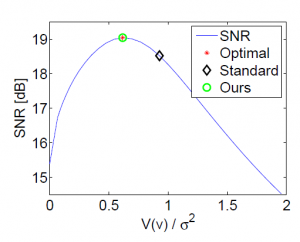
A general scale space algorithm is presented for denoising signals and images with spatially varying dominant scales. The process is formulated as a partial differential equation with spatially varying time. The proposed adaptivity is semi-local and is in conjunction with the classical gradient-based diffusion coefficient, designed to preserve edges. The new algorithm aims at maximizing a local SNR measure of the denoised image. It is based on a generalization of a global stopping time criterion presented recently by the author and colleagues. Most notably, the method works well also for partially textured images and outperforms any selection of a global stopping time. Given an estimate of the noise variance, the procedure is automatic and can be applied well to most natural images.

Tags:  ,  , 

diagram

Estimation of optimal PDE-based denoising in the SNR sense

G. Gilboa, N. Sochen, Y.Y. Zeevi, “Estimation of optimal PDE-based denoising in the SNR sense”, IEEE Trans. on Image Processing Vol. 15, No. 8, pp. 2269-2280, 2006.

Abstract:

This paper is concerned with finding the best PDE-based denoising process, out of a set of possible ones. We focus either on finding the proper weight of the fidelity term in the energy minimization formulation, or on determining the optimal stopping time of a nonlinear diffusion process. A necessary condition for achieving maximal SNR is stated, based on the covariance of the noise and the residual part. We provide two practical alternatives for estimating this condition, by observing that the filtering of the image and the noise can be approximated by a decoupling technique, with respect to the weight or time parameters.

Our automatic algorithm obtains quite accurate results on a variety of synthetic and natural images, including piecewise smooth and textured ones. We assume that the statistics of the noise were previously estimated. No a-priori knowledge regarding the characteristics of the clean image is required .

A theoretical analysis is carried out, where several SNR performance bounds are established for the optimal strategy and for a widely used method, wherein the variance of the residual part equals the variance of the noise.

photograph

Nonlocal Convex Functionals for Image Regularization

G. Gilboa, J. Darbon, S. Osher and T. Chan, Nonlocal Convex Functionals for Image Regularization. UCLA CAM Report 06-57

Abstract:

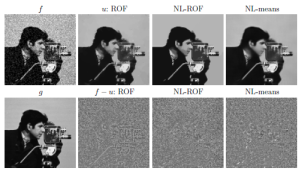
We examine weighted nonlocal convex functionals. The weights determine the affinities between different regions in the image and are computed according to image features. The L1 energy of this type can be viewed as a nonlocal extension of total-variation. Thus we obtain non-local versions of ROF, TV-flow, Bregman iterations and inverse-scale-
space (based on nonlocal ROF). Constructing the weights using patch distances, similarly to the nonlocal-means of Buades-Coll-Morel results in very robust and powerful regularizations. The flows and minimizations are computed efficiently by extending some recently proposed graph-cuts techniques. Numerical results which illustrate the performance of such models are presented.