CVPR 2023: BASiS – Batch Aligned Spectral Embedding Space

Or Streicher, Ido Cohen, Guy Gilboa; Proceedings of the IEEE/CVF Conference on Computer Vision and Pattern Recognition (CVPR), 2023, pp. 10396-10405

CVPR Repository

Code

Arxiv preprint 

Graph is a highly generic and diverse representation, suitable for almost any data processing problem. Spectral graph theory has been shown to provide powerful algorithms, backed by solid linear algebra theory. It thus can be extremely instrumental to design deep network building blocks with spectral graph characteristics. For instance, such a network allows the design of optimal graphs for certain tasks or obtaining a canonical orthogonal low-dimensional embedding of the data. Recent attempts to solve this problem were based on minimizing Rayleigh-quotient type losses. We propose a different approach of directly learning the eigensapce. A severe problem of the direct approach, applied in batch-learning, is the inconsistent mapping of features to eigenspace coordinates in different batches. We analyze the degrees of freedom of learning this task using batches and propose a stable alignment mechanism that can work both with batch changes and with graph-metric changes. We show that our learnt spectral embedding is better in terms of NMI, ACC, Grassman distance, orthogonality and classification accuracy, compared to SOTA. In addition, the learning is more stable.
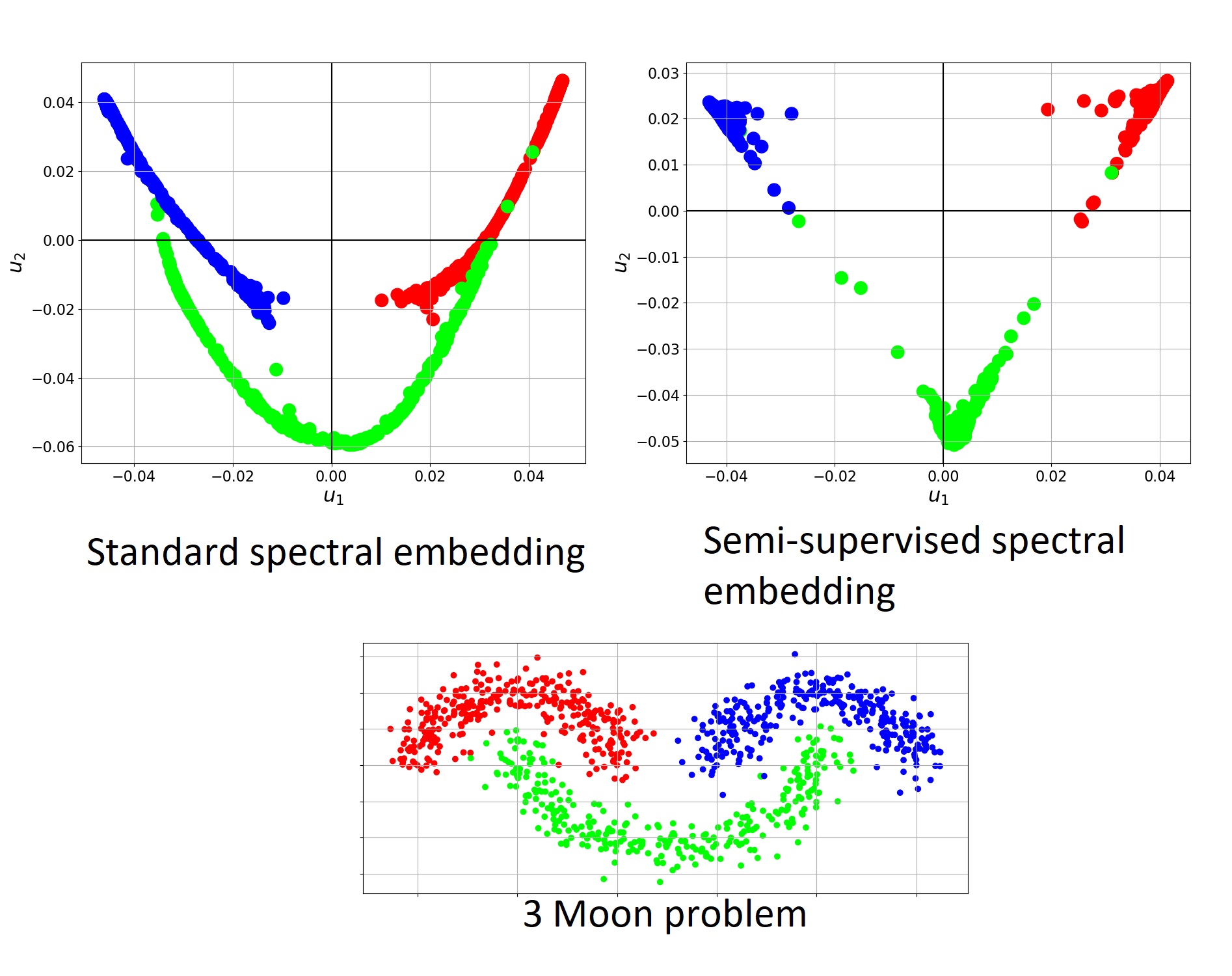
Graph Laplacian for Semi-Supervised Learning, accepted to SSVM-2023

Or Streicher, Guy Gilboa, accepted to SSVM 2023 (oral)

9th International Conference, SSVM 2023, Santa Margherita di Pula, Italy, May 21–25, 2023, Proceedings, Springer LNCS 14009, pp. 250-262, 2023.

Springer conference proceedings

Arxiv preprint

Code

Abatract

Semi-supervised learning is highly useful in common scenarios
where labeled data is scarce but unlabeled data is abundant. The
graph (or nonlocal) Laplacian is a fundamental smoothing operator for
solving various learning tasks. For unsupervised clustering, a spectral embedding
is often used, based on graph-Laplacian eigenvectors. For semisupervised
problems, the common approach is to solve a constrained
optimization problem, regularized by a Dirichlet energy, based on the
graph-Laplacian. However, as supervision decreases, Dirichlet optimization
becomes suboptimal. We therefore would like to obtain a smooth
transition between unsupervised clustering and low-supervised graphbased
classification.
In this paper, we propose a new type of graph-Laplacian which is adapted
for Semi-Supervised Learning (SSL) problems. It is based on both density
and contrastive measures and allows the encoding of the labeled data directly
in the operator. Thus, we can perform successfully semi-supervised
learning using spectral clustering. The benefits of our approach are illustrated
for several SSL problems.