
Yossi, Shachar & Ilya – gathering data with the drone operators.

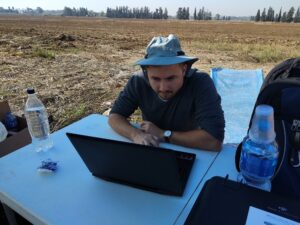
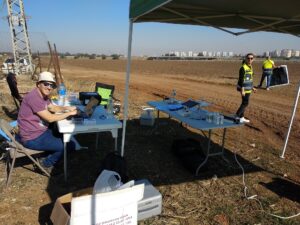
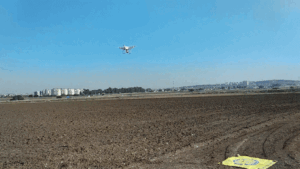
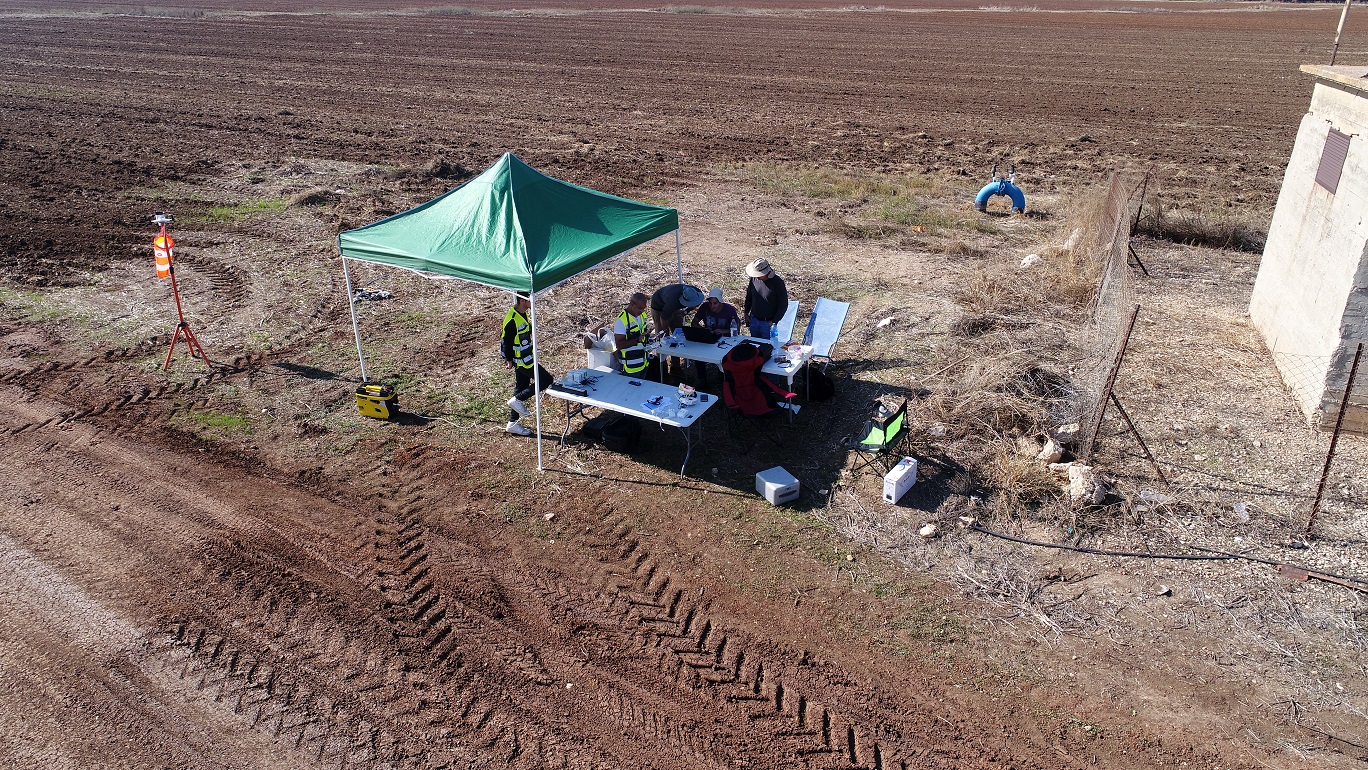
Yossi, Shachar & Ilya – gathering data with the drone operators.
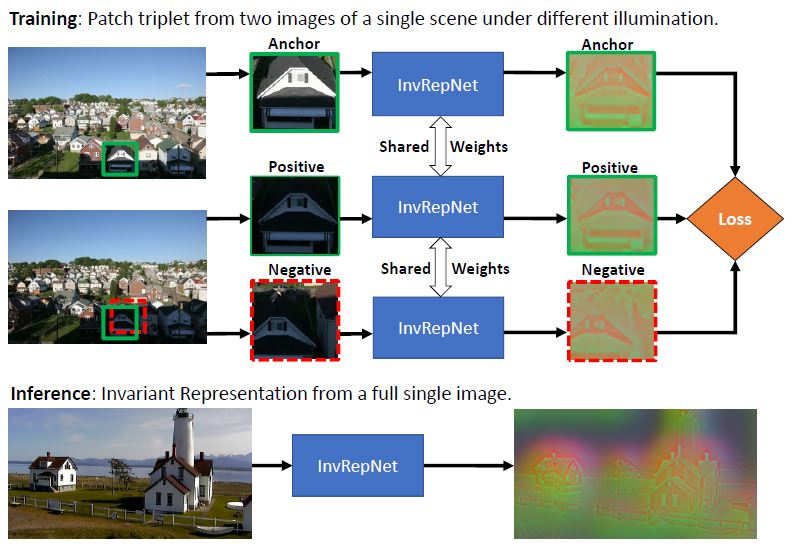
We propose a new and completely data-driven approach for generating an unconstrained illumination invariant representation of images. Our method trains a
neural network with a specialized triplet loss designed to emphasize actual scene
changes while downplaying changes in illumination. For this purpose we use the
BigTime image dataset, which contains static scenes acquired at different times.
We analyze the attributes of our representation, and show that it improves patch
matching and rigid registration over state-of-the-art illumination invariant representations.
We point out that the utility of our method is not restricted to handling
illumination invariance, and that it may be applied for generating representations
which are invariant to general types of nuisance, undesired, image variants.
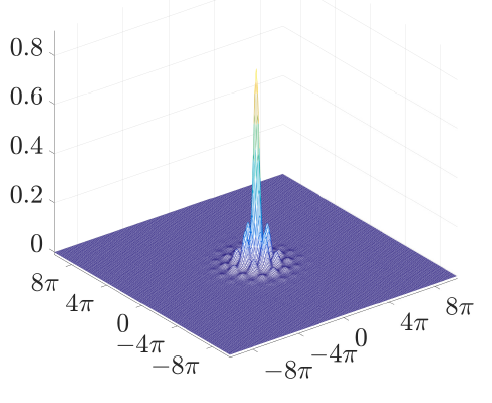
This work is concerned with computing nonlinear eigenpairs, which model solitary waves and various other physical phenomena. We aim at solving nonlinear eigenvalue problems of the general form
$T(u)=\lambda Q(u)$. In our setting $T$ is
a variational derivative of a convex functional (such as the Laplacian operator with respect to the Dirichlet energy),
$Q$ is an arbitrary bounded nonlinear operator and $\lambda$ is an unknown (real) eigenvalue.
We introduce a flow that numerically generates an eigenpair solution by its steady state.
Analysis for the general case is performed, showing a monotone decrease in the convex functional throughout the flow.
When $T$ is the Laplacian operator, a complete discretized version is presented and analyzed. We implement our algorithm on \ac{KdV} and \ac{NLS} equations in one and two dimensions.
The proposed approach is very general and can be applied to a large variety of models. Moreover, it is highly robust to noise and to perturbations in the initial conditions, compared to classical Petiashvili-based methods.
Tags: eigenpairs , nonlinear eigenfunction analysis , normalized reaction diffusion , solitons
Many thanks to the whole group for contributing, commenting and proof-reading the new book.
A 4 year grant NoMADS, Nonlocal Methods for Arbitrary Data Sources, as part of the RISE program, started on March 2018.
Includes Collaboration between universities (Munster, Cambridge, UCLA, Bordeaux, Carnegie Mellon, Technion and more..) and industry.
The paper, based on the master thesis of Raz Nossek is now accepted (Sept 2017):
R. Nossek & G. Gilboa, “Flows generating nonlinear eigenfunctions”, Journal of Scientific Computing.
(a pdf of the accepted version will be published soon, see arXiv version)

Ety’s paper in IEEE Trans. on Image Processing is published, “Blind Facial Image Quality Enhancement Using Non-Rigid Semantic Patches “.
Tal and Guy participated in a workshop in Cambridge (Newton Institute) on Variational methods, new optimisation techniques and new fast numerical algorithms.
Tal presented a poster on Spectral TV Hashing.
Guy presented a talk: Nonlinear spectral analysis – beyond the convex case
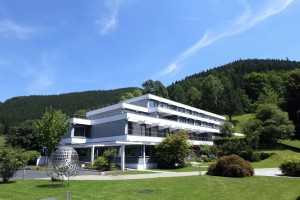
Participating in a workshop on Mathematical Imaging and Surface Processing at the Oberwolfach Math Institute, Germany, January 2016.
Requirements
Description of Position
To Apply
Send mail to Guy Gilboa with your CV.